

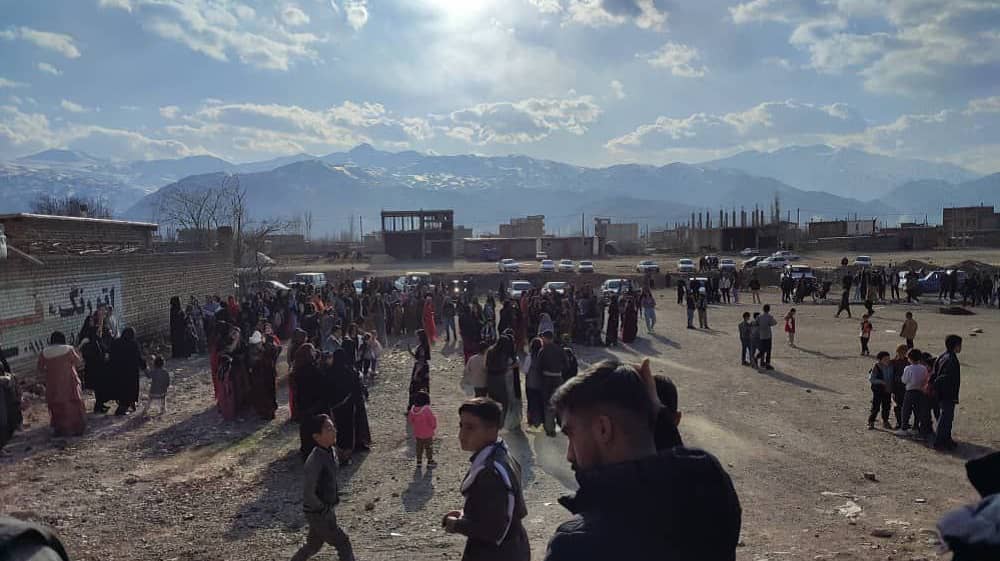
As the Iranian New Year unfolds, widespread protests and acts of defiance continue across the country, highlighting growing public outrage against the clerical regime. Demonstrations by farmers and workers, ethnic repression, and a wave of cemetery memorials for slain protesters marked the first week of the year 1404 in Iran.
On March 25, farmers in Isfahan staged a protest rally in front of the provincial water department, demanding immediate access to irrigation water. They reiterated their central slogan: “Water from Zayandeh Rud is our absolute right.” The demonstration was part of a broader, ongoing protest movement against the regime’s mismanagement of water resources in central Iran.
On the same day, in Khatunabad, Kerman Province, southeast Iran, workers gathered in protest, voicing grievances over deteriorating working conditions, unpaid wages, and the government’s failure to address economic hardship. The rally added to a surge in labor unrest that has intensified across the country amid deepening poverty.
Meanwhile, reports from Sistan and Baluchestan Province revealed fresh instances of state repression. On March 23, security forces — referred to by locals as “the regime’s thugs” — demolished the under-construction home of a Baluch citizen on Fazeli Street in Zahedan. A similar act occurred on March 21 in Iranshahr, where the unfinished home of a Baluch laborer was destroyed. These demolitions are widely viewed as part of a long-standing campaign of discrimination and intimidation against Iran’s marginalized ethnic communities.
March 25—Tehran, Iran
Families of political prisoners rally in front of Evin prison in tandem with the 61st week of the "No to Executions Tuesdays" campaign, protesting death sentences for their loved ones.#IranProtestspic.twitter.com/6pCdMOqjUk— People's Mojahedin Organization of Iran (PMOI/MEK) (@Mojahedineng) March 25, 2025
Also on March 23, farmers in eastern Isfahan held a pre-dawn protest beside their tractors, demanding the reopening of the Zayandeh Rud River by March 25. They directed their message to the provincial governor, warning that failure to release water would escalate the protests.
Across the country, citizens turned Nowruz into a moment of resistance, with families of slain protesters gathering at cemeteries to honor their loved ones. These tributes took place in cities including Tehran, Qazvin, Mahabad, Diwandarreh, Kermanshah, Zanjan, Sanandaj, Saqqez, Boukan, Ezeh, Karaj, Islamshahr, and others. Graves were adorned with flowers, handwritten notes, and messages of remembrance. In Mahabad, the child of Simko Moloudi, a protester killed in the uprising, was heard speaking in Kurdish: “Happy New Year to you, father, and to all the martyrs.” His grave bore the inscription: “Do not cry at my grave; I am proud to be a martyr of the people.”
In Tehran, floral tributes were laid beside the graves of Mohsen Shekari, Sarina Saeedi, and others. One grieving mother wrote: “This year, someone is forever missing from our Haft-Sin (Iran’s traditional Nowruz table). It was a year of tears… But spring is coming. We will pass through this.”
March 25—Isfahan, central Iran
Protest rally by farmers in front of the water department, demanding access to water for irrigation.#IranProtestspic.twitter.com/FIQC8RsNv7— People's Mojahedin Organization of Iran (PMOI/MEK) (@Mojahedineng) March 25, 2025
In stark contrast to the joyful Nowruz celebrations taking place across many Kurdish towns and villages, where citizens welcomed the New Year with traditional khaakipoosh (earth-toned Kurdish dress), jamana headscarves, and group dances like halparke, the Islamic Revolutionary Guard Corps (IRGC) forcibly disrupted festivities in the village of Dizaj (Deza) in the Margavar region of Urmia County. According to local sources, IRGC forces blocked roads, summoned residents, and issued threats to prevent any public gathering. Despite such crackdowns, New Year ceremonies have continued in parts of Kurdistan, fueled by the community’s defiance and cultural resilience.
In a rare public admission, police chief Ahmad-Reza Radan revealed that 75 regime forces were killed in the previous year, 1403. His statement — “We gave 75 martyrs from the borders to the cities” — was intended to highlight regime sacrifice, but in fact underscores the scale of popular resistance and public anger directed at the clerical dictatorship.