

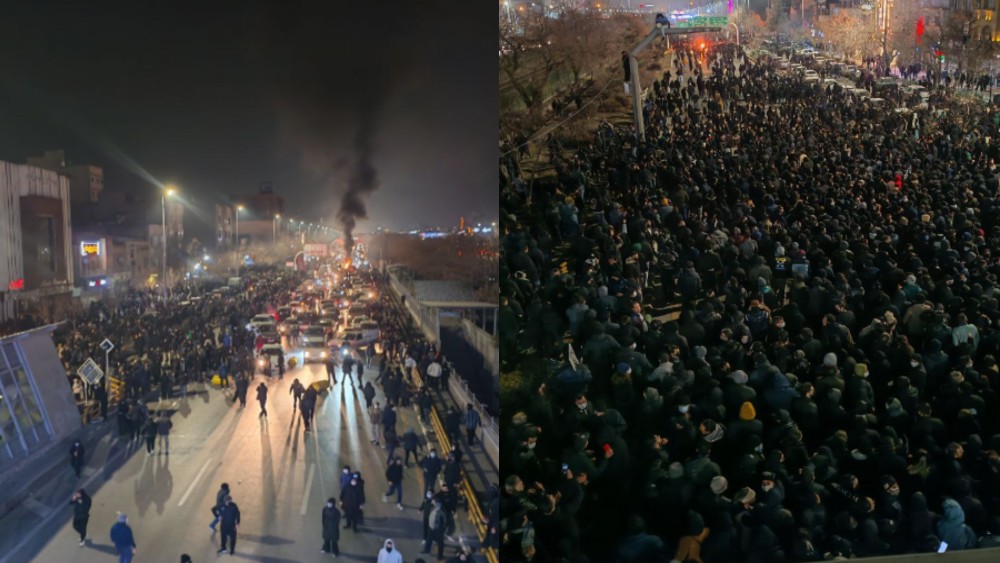
The nationwide uprising against the religious dictatorship in Iran has entered a critical new phase. As the sun set on Thursday, January 8, 2026, the twelfth consecutive day of protests, the dynamic on the streets shifted from demonstration to active confrontation. What began on December 28, 2025, as a reaction to the collapse of the rial and soaring inflation has rapidly evolved into a full-scale political revolution demanding the overthrow of the regime.
Thursday marked a violent turning point characterized by two distinct developments: a nationwide general strike that paralyzed major commercial centers, and the regime’s resort to desperate measures, including a total internet blackout and the deployment of foreign proxy forces to suppress the population.

The Regime’s Desperation: Mercenaries and Digital Blockades
As the uprising spreads to every corner of the country, the clerical regime is exhibiting signs of severe strain and a lack of reliable manpower. Reports emerging from Kermanshah on Thursday evening indicate that the Islamic Revolutionary Guard Corps (IRGC) has deployed Arabic-speaking members of Iraq’s Hashd al-Shaabi (Popular Mobilization Forces) to aid in the suppression of protesters. Local witnesses in the restive city confirmed the presence of these foreign mercenaries participating alongside the IRGC, a move that signals the regime’s growing distrust in its own rank-and-file forces and its desperation to quell the unrest by any means necessary.
⚠️ Confirmed: Live metrics show #Iran is now in the midst of a nationwide internet blackout; the incident follows a series of escalating digital censorship measures targeting protests across the country and hinders the public's right to communicate at a critical moment 📉 pic.twitter.com/vKpVUUmNJs
— NetBlocks (@netblocks) January 8, 2026
Coinciding with this deployment, the regime initiated a severe information blockade. NetBlocks confirmed a nationwide internet blackout on Thursday night, with specific, targeted disruptions on the TCI backbone in Kermanshah. This digital darkness is a standard tactic used by the mullahs to conceal the scale of their violence and hinder coordination among protesters.
However, the regime can no longer hide the lethality of its crackdown. In a rare admission on state television, the deputy governor of Khorasan Razavi acknowledged that five demonstrators were killed by security forces in Chenaran on January 7, attempting to frame the narrative before independent reports could circulate.
Radicalization of the Street: Targeting the Apparatus of Suppression
The youth of Iran have moved beyond chanting to dismantling the physical symbols of the theocracy. On Thursday, protesters in Isfahan set fire to the headquarters of the state broadcaster, a significant escalation targeting the primary apparatus of the regime’s propaganda machine. Similar scenes played out in Gorgan, where the governorate building was torched, and in Lordegan, where enraged residents set the governor’s office ablaze.
⚠️ Confirmed: Live metrics show #Iran is now in the midst of a nationwide internet blackout; the incident follows a series of escalating digital censorship measures targeting protests across the country and hinders the public's right to communicate at a critical moment 📉 pic.twitter.com/vKpVUUmNJs
— NetBlocks (@netblocks) January 8, 2026
In Tehran, the capital has become a flashpoint of resistance. Rebellious youth in the Mehrabad district set fire to a Basij base after security forces attempted to attack their demonstration. At Sattarkhan Bridge, vehicles belonging to the IRGC Basij forces were engulfed in flames. In Naziabad, repressive forces were forced to flee the scene after failing to disperse the crowd, leaving their motorcycles behind to be burned by protesters.
The confrontation has also seen citizens engaging in armed self-defense. In the city of Sarableh, Ilam province, rebellious youths in the Asemanabad district seized an IRGC center. Meanwhile, in Varamin, following a shooting by the State Security Force (SSF) that injured a woman, youth clashed with the unit, resulting in the death of two regime agents.
January 8—Tehran, Iran
At Sattarkhan Bridge, protesters set fire to vehicles of IRGC Basij forces who were sent to crack down on the demonstrations.#IranProtests pic.twitter.com/UE37m2ManL— People's Mojahedin Organization of Iran (PMOI/MEK) (@Mojahedineng) January 8, 2026
The Human Cost: The Lordegan Massacre and Teenagers in the Crosshairs
The escalating resistance comes at a high price. The uprising in Lordegan, western Iran, turned into a bloody confrontation on January 7 and 8. Security forces opened fire on rallies, resulting in the martyrdom of eight protesters. Despite the massacre, the people of Lordegan stood their ground, blocking the Ahvaz road to prevent regime reinforcements from entering the city.
The People’s Mojahedin Organization of Iran (PMOI/MEK) has identified 44 martyrs since the uprising began. The list of victims highlights the indiscriminate nature of the regime’s violence, with several teenagers among the fallen. Identified martyrs include 17-year-old Mobin Yaghobzadeh from Khoshk-e Bijar, 16-year-old Mohammad Reza Karami from Malekshahi, and 18-year-old Reza Moradi Abdolvand from Azna.
“And every crimson flower that blooms from the blood of the fallen today carries the promise of freedom tomorrow.”
The deepest respect of the risen people of Iran goes to the eight vanguard protesters who were killed last night after hours of confrontation with the regime’s Basij…— Maryam Rajavi (@Maryam_Rajavi) January 8, 2026
Mrs. Maryam Rajavi, President-elect of the NCRI, honored the sacrifices of these young men and women. “The deepest respect of the risen people of Iran goes to the eight vanguard protesters who were killed last night,” Rajavi stated regarding the Lordegan massacre. “Their sacrifice will only strengthen the nation’s resolve for change.”
National Paralysis: General Strikes Bridge the Divide
Parallel to the street battles, a massive wave of strikes has swept across the country, signaling a complete rupture between the traditional merchant class and the state. On the morning of January 8, the Grand Bazaars of Tehran and Tabriz—historically significant centers of political gravity—shut their doors.
January 8—Iran
Strikes in Divandarreh, Ravansar, Marivan, Baneh.#IranProtests #IranRevolution2026 pic.twitter.com/QBB4CxjMs7— People's Mojahedin Organization of Iran (PMOI/MEK) (@Mojahedineng) January 8, 2026
The strikes were total in the Kurdistan province, with Sanandaj, Marivan, Baneh, and Saqqez reporting complete shutdowns. The movement extended south to Bandar Abbas and Kerman, and east to Sabzevar and Neyshabur. In dozens of cities, from the diesel markets of Kermanshah to the commercial hubs of Urmia and Isfahan, shopkeepers refused to open, effectively paralyzing the regime’s economic flow and demonstrating a unity of purpose with the protesters in the streets.
Rejection of All Dictatorships: “No to Shah, No to Mullahs”
As the uprising enters its second week, the political demands of the Iranian people are becoming increasingly specific and unified. The chants echoing through the country reject both the current theocratic dictatorship and any return to monarchical rule.
January 8—Urmia, northwest Iran
People rallied for nightly anti-regime protests. In their protests, they chanted, "Azarbaijan is honorable, Pahlavi does not have honor," rejecting the mullahs' regime and a return to the shah dictatorship.#IranProtests pic.twitter.com/OUv59kSPHt— People's Mojahedin Organization of Iran (PMOI/MEK) (@Mojahedineng) January 8, 2026
In Urmia, northwest Iran, protesters chanted, “Azarbaijan is honorable, Pahlavi does not have honor,” explicitly rejecting the remnants of the deposed monarchy alongside the current regime. In Lumar, Ilam province, the crowd chanted, “Mullahs must get lost!” while in Hamedan, the people cried out, “We won’t have a country as long as the mullahs are in power.”
The combination of nationwide economic paralysis, the burning of government centers, and the failure of foreign mercenaries to intimidate the public suggests that the Iranian regime is facing an existential crisis. The people, having paid a heavy price in blood, appear unwilling to look back and are determined to get rid of the regime for good.