

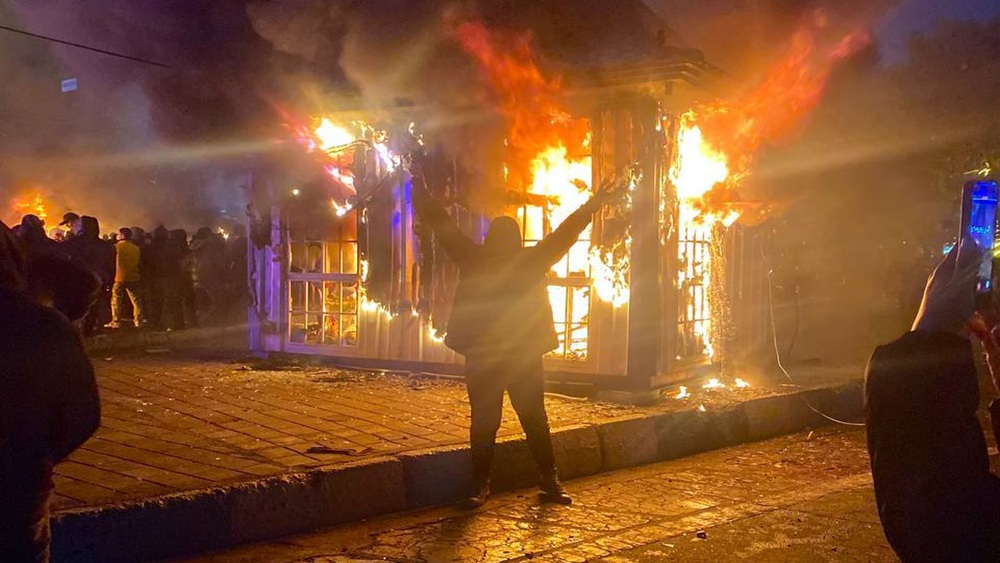
As the nationwide uprising in Iran enters its 18th consecutive day, the clerical regime is exhibiting signs of desperation, resorting to extreme violence on the streets and expedited judicial threats behind prison walls. Despite a near-total internet blackout that has lasted over 132 hours, reports filtering out of the country confirm that protests have not only persisted but have intensified into armed confrontations in several provinces.
According to the People’s Mojahedin Organization of Iran (PMOI/MEK), the number of martyrs since the uprising began on December 28 has now exceeded 3,000. On Tuesday, the NCRI Secretariat released the names of an additional 38 martyrs, five of whom were women. The victims range from 17-year-old youths like Amirali Zaheri in Tuyserkan and Ribin Moradi in Tehran, to older citizens like 55-year-old Ali Dehghan Joughan. These verified names are merely a fraction of the casualties, as the digital blockade continues to obscure the full scale of the crackdown.
“Coup de Grâce” and Urban Warfare
The violence deployed by the Islamic Revolutionary Guard Corps (IRGC) and Basij paramilitary forces has escalated into what witnesses describe as war crimes. Reports received by Simay Azadi from the Sattarkhan district in Tehran detail a horrific tactic where security forces are delivering coup de grâce—finishing shots—to injured protesters lying on the streets. The indiscriminate nature of the violence was highlighted by a report of a Tehran resident shot dead simply for stepping outside to dispose of trash.
🚨 EXCLUSIVE: COUP DE GRÂCE: Security Forces “Finishing Off” Injured Protesters in Sattarkhan, Tehran
Reports received by Simay Azadi describe a horrific crackdown in recent days.pic.twitter.com/sLvNb2jlf6
According to witnesses security forces engaged in indiscriminate killing,…— SIMAY AZADI TV (@en_simayazadi) January 14, 2026
Simultaneously, the regime has launched a house-to-house crackdown to sever the population’s last remaining links to the outside world. On Tuesday, security agents raided residential homes across various cities to confiscate satellite dishes and identify Starlink internet terminals, aiming to enforce a total information blackout.
The Judiciary’s Rush to Execute
Facing an inability to quell the unrest through street violence alone, the regime’s Judiciary has signaled an intent to begin mass executions. On Wednesday, January 14, Gholam-Hossein Mohseni-Eje’i, the head of the Judiciary, visited Tehran’s prisons for five hours. In a chilling admission filmed by state media, Eje’i demanded the “immediate execution” of detained protesters.
“If we don’t do this today, it will lose its effect two months from now,” Eje’i stated, explicitly acknowledging that the judicial process is being used as a tool for immediate terror rather than justice. “Those who burned people… we must act quickly.”
This rushed legal processing comes as human rights organizations warn of imminent mass hangings.
A “Warlike Situation” Nationwide
Despite the threats and the crackdown, the operational tempo of rebellious youth has increased. In Mashhad, the confrontation has turned lethal for the regime’s forces; a colonel and three Basij members were reported killed while firing upon demonstrators.
In the west, Kermanshah has become a flashpoint of hit-and-run battles that lasted throughout Tuesday night. The situation has deteriorated to the point where the regime was forced to deploy reinforcements from Qasr-e Shirin, Ravansar, and Javanrud to regain control. Similarly, Shahr-e Babak in Kerman province is described as being in a “warlike situation,” with hundreds arrested and the city’s intelligence chief injured in clashes.
In the capital, Tehran, crowds in the Sadeghieh district chanted “Death to the dictator,” while fierce clashes erupted in Haft Howz, Tehranpars, and Naziabad, where agents fired pellet guns indiscriminately at citizens.
On Tuesday night, Tehran and many other cities once again became the scene of direct confrontation between the people and rebellious youth on one side, and the regime’s violent IRGC forces on the other.
Yet the fearless youth, alongside resolute women and girls, are bringing the…— Maryam Rajavi (@Maryam_Rajavi) January 14, 2026
Mrs. Maryam Rajavi, President-elect of the NCRI, praised the determination of the youth and women of Iran. “In this ruthless confrontation, in which thousands of innocent Iranians have been killed over the past two weeks, neutrality is not an option,” Mrs. Rajavi stated. She reiterated that the regime’s deployment of heavy weapons and digital lockdowns are symptoms of failure, not strength, as the people pave the way for democracy.
International Isolation and Calls for Action
The international community is increasingly moving beyond condemnation toward tangible action. The Swedish Ministry for Foreign Affairs summoned the Iranian ambassador on Tuesday to lodge a formal protest against the use of lethal force.
If not now, then when?
It's time for Europe to act decisively.
It’s time for stronger sanctions against those sustaining the Iranian regime through violence, killings and repression.
It’s time for the Islamic Revolutionary Guard Corps to finally be designated as a terrorist… pic.twitter.com/zqtBZo1BMW
— Roberta Metsola (@EP_President) January 14, 2026
In the European Parliament, President Roberta Metsola asked, “If not now, then when?” regarding the designation of the IRGC as a terrorist organization. This sentiment was echoed by British MPs Bob Blackman and Priti Patel, who emphasized that the Iranian people are “dying for their freedom” and that the UK government must proscribe the IRGC immediately.
From the United States, bipartisan support remains strong. Senator Dave McCormick noted that Iranians are being “killed in cold blood for demanding basic dignity,” while the House Foreign Affairs Committee Majority stated that “Khamenei’s only way to cling to power now is by slaughtering innocent Iranians… That’s not a winning strategy.”
The Ayatollah’s fall is inevitable. The Rial is worthless and the regime can’t fund even basic services. Khamenei's only way to cling to power now is by slaughtering innocent Iranians rising up to protest. That’s not a winning strategy. pic.twitter.com/Ynv6ebAGcn
— House Foreign Affairs Committee Majority (@HouseForeignGOP) January 13, 2026