

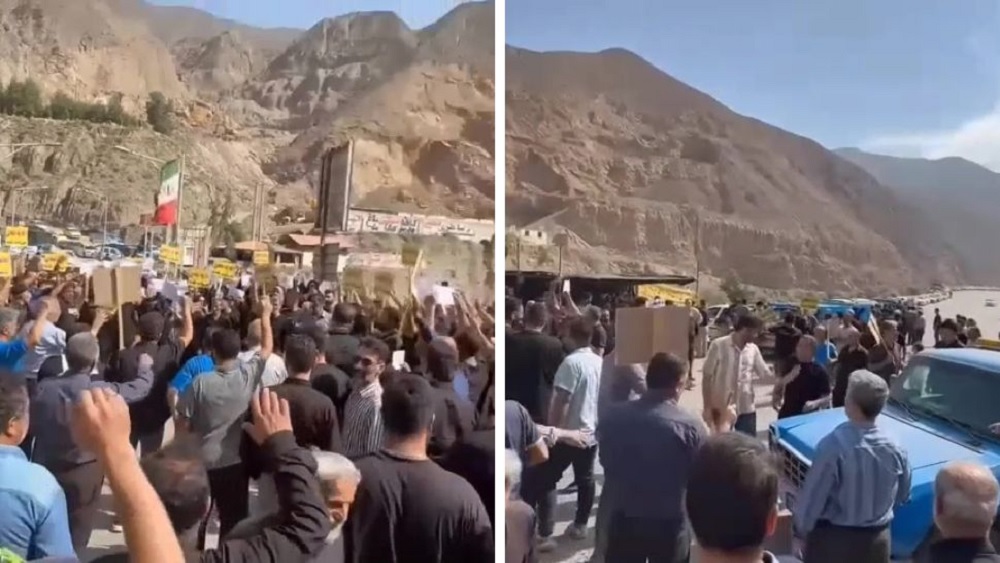
A new and potent wave of protests has erupted across Iran, exposing the systemic decay of the clerical regime now headed by Masoud Pezeshkian. In recent days, citizens from industrial hubs to rural towns have taken to the streets, their diverse grievances converging into a single, powerful outcry against a state defined by corruption and a failure to provide the most basic necessities of life.
The protests highlight a government that cannot even keep the lights on. In Khoshkebijar, a city in the northern Gilan province, citizens held a large rally, their chants cutting to the core of the regime’s failure: “Water, electricity, life, are our certain right,” and “Death to incompetence.”
July 26—Khoskebijar, northern Iran
Residents protest frequent and prolonged water and electricity outages, chanting "Water, electricity, life, is our rightful demand."#IranProtestspic.twitter.com/tzhwDuNdXI— People's Mojahedin Organization of Iran (PMOI/MEK) (@Mojahedineng) July 26, 2025
In the industrial zones of Khorramdasht and Siahsang east of Tehran, the crisis has brought commerce to a halt. Business owners and manufacturers gathered to protest prolonged, unscheduled power outages that have shut down production lines and forced them to lay off workers. The regime’s only response was to dispatch security forces to disperse the crowds.
Beyond incompetence, the protests reveal a system built on plunder. In Mashhad, poultry farmers gathered to condemn the actions of their state-affiliated union. As one protester stated, their situation is dire: “We have been destroyed, and no one is accountable; the union that was supposed to be our defender has become an instrument for our elimination.”
July 26—Mashhad, northeast Iran
Chicken farmers protest the severe crisis in the poultry industry due to mismanagement by the state-backed Mihan Union, which fails to support farmers and has instead become a lever to put pressure on them.#IranProtestspic.twitter.com/eGRvc7LgqR— People's Mojahedin Organization of Iran (PMOI/MEK) (@Mojahedineng) July 26, 2025
In the port city of Anzali, merchants and owners from the fire-ravaged Venous Commercial Complex held a protest, citing not just an accident but systemic rot: an inept board of directors, financial ambiguity, and failed safety systems. Some spoke of a “breach of trust,” signaling a belief that corruption, not just negligence, was to blame for their ruin.
Crucially, the anger is no longer confined to local issues but is being directed at the very top of the dictatorship. In Baladeh, Mazandaran province, environmental activists protesting the destructive operations of state-sanctioned mines chanted, “Death of nature is our death,” framing the regime’s policies as an existential threat.
The ultimate target of the people’s fury was made explicit in a symbolic act in Mashhad. A citizen, protesting poverty and power outages, directly addressed the Supreme Leader, Ali Khamenei, declaring, “Children are hungry for bread, and the dough that could have filled a table spoils. Is this justice?”
July 26—Anzali, northern Iran
Protest by owners and merchants at the Venous Mall, following a large fire that occurred earlier this week. The protest highlights mismanagement by authorities, including the absence of surveillance footage during the fire, non-functional fire… pic.twitter.com/Bo5N69dcHH— People's Mojahedin Organization of Iran (PMOI/MEK) (@Mojahedineng) July 26, 2025
These interconnected protests are a clear verdict on four decades of theocratic rule. The Iranian people have demonstrated that they see the source of their suffering not in isolated policy failures, but in the corrupt and incompetent nature of the regime itself. Their courageous and growing resistance is the true voice of the nation. The international community must recognize this reality and stand in solidarity with the people of Iran and their organized opposition in their quest to establish a democratic and accountable government.