

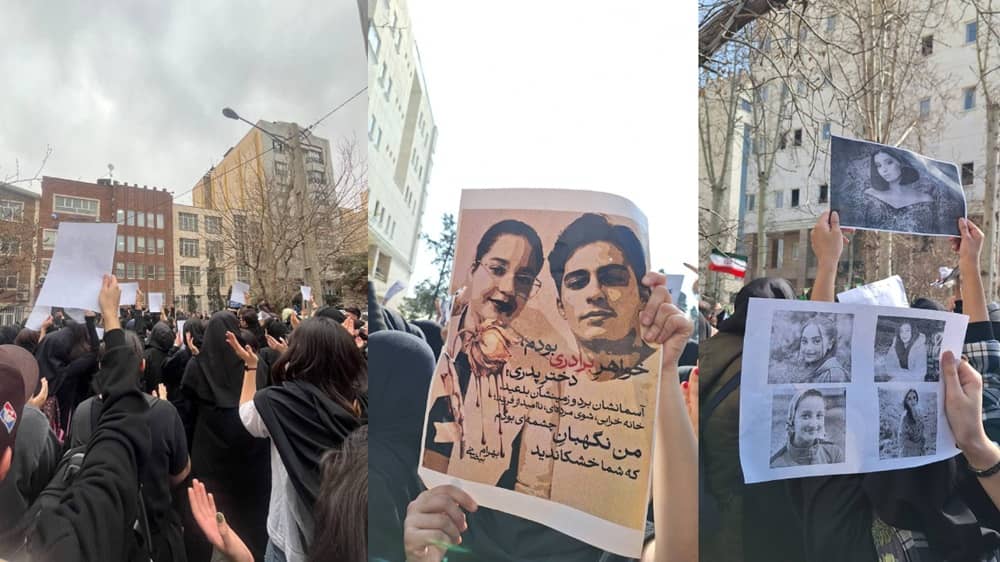
Students at universities across Iran staged new anti-government protests on Tuesday, where a widening campus movement marked by anti-regime chants, clashed with pro-regime forces. Reports suggest demonstrations expanded from Tehran to Mashhad and Isfahan and framed the mobilization as the fourth day of a student-led uprising.
Anti-authoritarian slogans dominate campus protests
Some of the most prominent chants came from the University of Tehran and Amirkabir University of Technology, where students were said to have shouted:
-
“Death to the oppressor, whether Shah or Supreme Leader”
-
“No monarchy, no supreme leadership — democracy, equality”
Those slogans are notable because they reject both Iran’s current clerical system and any return to monarchy, underscoring a line that has become increasingly visible in parts of the student movement: opposition to authoritarian rule in any form.
At Sharif University of Technology, the report said students tore up images of senior Iranian leaders and chanted, “This is the year of blood; Seyed Ali [Khamenei] will be overthrown.” At Al-Zahra University, students held photographs of people killed in the January protests and blocked Basij members from entering a gathering.
February 24—Mashhad, northeast Iran
Students at Shandiz University held an anti-regime protest rally, chanting, "Students will die but won't give in to disgrace!"#IranProtests pic.twitter.com/lS9av3dYSj— People's Mojahedin Organization of Iran (PMOI/MEK) (@Mojahedineng) February 24, 2026
Memorials and mourning tied to new protest momentum
A central theme of this week’s campus actions were memorial events for those killed in the January unrest. Students held commemorations for two slain protesters — Mohammadreza Moradali and Zahra (Raha) Bohloulipour — at Tehran University faculties, with chants describing the dead as sacrifices “for the homeland.”
Calls for gatherings framed as candlelight memorials, including one at Al-Zahra University, asked students to wear black and gather “in memory of all those no longer among us.”
That combination of mourning and political mobilization is a familiar pattern in Iran, where memorial ceremonies — especially on the 40th day after a death — have historically served as flashpoints for renewed demonstrations.
More footage of the clashes between students and the regime's Basij and security agents at Khajeh Nasir University.#IranProtests pic.twitter.com/bbCQBBpe1y
— People's Mojahedin Organization of Iran (PMOI/MEK) (@Mojahedineng) February 24, 2026
Clashes, security pressure, and allegations of campus intimidation
Local reports suggest a heavy security presence at multiple universities, including plainclothes agents and Basij forces, with students at several campuses confronted them directly:
-
clashes at Khajeh Nasir University, where pepper spray was used against students;
-
confrontations at Iran University of Science and Technology;
-
large numbers of plainclothes forces at “National University” (a common colloquial reference to Shahid Beheshti University);
-
and a broad Basij presence at Al-Zahra University.
The Al-Zahra University administration published a warning, threatening disciplinary action against students attending “unauthorized and illegal” gatherings.
Furthermore, a Sharif University disciplinary official offered to lift entry bans on some students if a protest did not spread to the university’s main gate, while threatening additional bans if it did.
These accounts reflect a pattern seen in past campus unrest: a mix of formal disciplinary pressure, security deployment, and efforts to contain protests inside university grounds before they move into more public spaces.
🎓 Iran Protests Update — Student Protests Across Tehran Universities (Roundup Video)
Students across Tehran universities raised defiant slogans calling for freedom and accountability:
📍 University of Tehran — “We stand to the end, sworn by the blood of our fallen.”
📍… pic.twitter.com/EjLxyPdVcb— SIMAY AZADI TV (@en_simayazadi) February 24, 2026
Coordinated calls for strikes and class boycotts
Beyond street-style demonstrations, there has been a growing organizational coordination inside the student movement. Students at several universities — including Beheshti (referred to by activists as “National University”), Iran University of Science and Technology, and Khajeh Nasir — issued joint statements calling for class boycotts and coordinated protests.
A lengthy statement from Sharif University students set out explicitly political demands, including:
-
a democratic, secular, non-hereditary system;
-
an end to dictatorship “whether in the form of a shah or a sheikh” (clerics);
-
and rejection of attempts to redirect student protests toward monarchist politics.
A separate statement from students at Iran’s Islamic Azad University network condemned recent killings and arrests and called for nationwide solidarity across social groups, including workers, teachers, and students.
More footage of the clashes between students and the regime's Basij and security agents at Khajeh Nasir University.#IranProtests pic.twitter.com/bbCQBBpe1y
— People's Mojahedin Organization of Iran (PMOI/MEK) (@Mojahedineng) February 24, 2026
Protests reported beyond Tehran
Demonstrations also took place in:
-
Isfahan University of Technology
-
Ferdowsi University of Mashhad
-
Sajjad University (Mashhad)
-
Soore University
-
University of Art
-
Gulf University (for a memorial gathering)
In Mashhad and Isfahan, chants were reported of “Death to the dictator” and “We swear by the blood of our friends, we will stand to the end.”
February 24—Tehran, Iran
Students at Khajeh Nasir University resumed their protests. During the rallies, the regime's security forces attacked the students at the dormitory and tried to disperse their rally, but they resisted.#IranProtests pic.twitter.com/t22iwPuSYB— People's Mojahedin Organization of Iran (PMOI/MEK) (@Mojahedineng) February 24, 2026
A movement with a clearer political message
What stands out most is the consistency of one message across campuses: students are not only opposing the current system, but also trying to define what should not replace it.
The repeated slogans — especially “Neither monarchy nor supreme leadership” and “Death to the oppressor, whether Shah or Supreme Leader” — suggest a movement trying to draw a firm line against both the clerical dictatorship and any restoration of monarchical rule.
That ideological clarity, whether it reflects the entire protest movement or a specific organized current within it, is becoming one of the most distinctive features of this phase of campus unrest.