

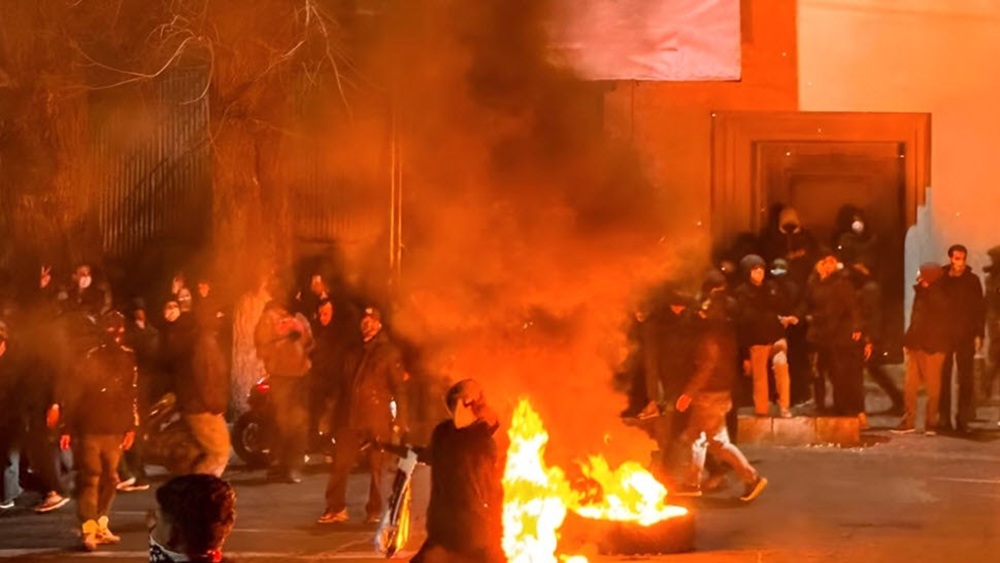
The nationwide uprising in Iran has entered a critical new phase, characterized by a marked escalation in confrontations between the populace and state security forces. As of late January, protests have engulfed over 400 cities, prompting senior officials of the clerical regime to publicly admit that the unrest has evolved from scattered riots into a coordinated “full-scale civil war” aimed at overthrowing the theocracy.
While the international community, led by the United Nations Human Rights Council (UNHRC), moves to document what legal experts are now calling an “extermination,” the situation on the ground remains volatile. Reports from the network of the People’s Mojahedin Organization of Iran (PMOI/MEK) indicate that despite a near-total internet blackout and the use of heavy machine guns against civilians, the momentum of the protests has not waned.
Defiance in Baluchistan and Strikes by Rebellious Youth
On Friday, January 23, 2026, the Sistan and Baluchestan province once again became the epicenter of defiance. Following Friday prayers, widespread demonstrations erupted in Zahedan, Rask, and Khash. Protesters, undeterred by the heavy security presence, marched through the streets chanting slogans that targeted the highest echelons of the regime. The chants included “Death to Khamenei,” “Death to the dictator,” and a particularly ominous warning for the Supreme Leader: “This year is the year of blood, Khamenei will be overthrown.” In Rask, the anger was directed specifically at the security apparatus, with crowds chanting “Death to the disgraceful IRGC” and “Disgraceful Basiji.”
NCRI Statement:
Rebellious youths escalate attacks on regime forces amid nationwide protests. Key highlights:
* Baluch Protests (Jan 23): Massive demos in Zahedan, Rask, Khash after prayers; chants of "Death to Khamenei," "Death to dictator," "Death to Basiji/IRGC." Protesters…— NCRI-FAC (@iran_policy) January 24, 2026
Parallel to the mass demonstrations, “Rebellious Youth” units have intensified operations against the regime’s suppression centers across the country. In Arak, on the night of January 22, youths in the Gerdoo neighborhood launched an attack on Police Station 12 (Razavi). The operation, which used incendiary devices and hit-and-run tactics, was reportedly launched to prevent the transfer of detained protesters, forcing security forces to evacuate the station.
Similar confrontations occurred in Shiraz on January 22, where youths clashed with Special Units in response to indiscriminate shooting by regime agents at residential homes. In Isfahan, on January 20, a Basij base in the Kuhpayeh region—a hub for organizing crackdowns on protesters—was targeted with incendiary devices, resulting in injuries to three regime agents.
The Human Toll: Adolescents Among the Slain
The intensification of the conflict has come at a staggering human cost. On January 24, the PMOI released the names of 94 additional martyrs of the uprising, bringing the total number of identified victims to 543. The newly released list highlights the indiscriminate nature of the regime’s lethal force.
Among the newly identified victims are 15 women and five adolescents between the ages of 13 and 16. The list includes 14-year-old Artin Lavahi from Rasht, 13-year-old Nazanin Zahra Salehi from Kermanshah, and 16-year-old Mohammad Matin Bagheri, also from Kermanshah. The geographic spread of the casualties—ranging from Rasht and Lahijan in the north to Tehran, Karaj, Isfahan, and Shiraz in the center, and Zahedan in the southeast—corroborates the nationwide scope of the crackdown.
NCRI Statement: Names of 94 Additional Martyrs in #Iran Announced, Including 15 Women and 5 Adolescentshttps://t.co/fSFwPrO5U3
— NCRI-FAC (@iran_policy) January 24, 2026
Regime Officials Admit to “Civil War” and Vulnerability
Perhaps the most telling indicator of the regime’s precarious position is the shift in rhetoric among its top officials. Gone are the dismissals of “scattered riots”; in their place is an admission of an existential threat.
Ali Akbar Pourjamshidian, Secretary of the regime’s Security Council, revealed the scale of the unrest on January 21, stating that more than 400 cities and 100 locations in Tehran were involved. He quantified the damage to the regime’s infrastructure, noting that “414 government buildings, 749 police vehicles, 120 Basij bases, and 750 banks were set on fire.” Even the regime’s President, Masoud Pezeshkian, conceded that “these developments are no longer mere protests and have turned into a project aimed at overthrowing the regime.”
Friday prayer leaders, who serve as the mouthpieces for Supreme Leader Ali Khamenei, have expressed deep panic. In Kerman, Khamenei’s representative Hassan Soleimani declared, “Today the country is in a completely war-like condition. We must be careful not to enter a civil war.” In Qom, Mohammad Saeedi Golpayegani admitted that “the most important target in these riots was the person of Khamenei.”
In Tehran, Friday Prayer leader Mohammad-Javad Haj-Ali-Akbari described the uprising as a “full-scale civil war” launched with “indescribable violence.” Attempting to project strength amidst the domestic unrest, he resorted to external threats, claiming that U.S. bases and investments in the region are “within the precise range of our missiles.”
International Condemnation: “The Worst Mass-Murder in Contemporary History”
While the regime attempts to crush the uprising militarily, the international community is documenting the atrocities. On January 23, the UN Human Rights Council adopted a resolution extending the mandate of the Independent International Fact-Finding Mission on Iran.
During the special session, Volker Türk, UN High Commissioner for Human Rights, reported that “thousands of people, including children,” have been killed, confirming the use of live ammunition by security forces. The session featured harrowing testimony regarding the scale of the violence. One of the speakers characterized the regime’s actions as an “extermination.”
Sara Hossain, Chair of the Fact-Finding Mission, described “haunting” evidence, including images from the Kahrizak morgue in Tehran showing hundreds of body bags piled atop one another. The UN resolution strongly deplored the violent crackdown and called for an urgent investigation into the “deaths of thousands of persons.”
The @UN_HRC’s adoption of a resolution by a clear majority condemning the clerical regime’s brutal suppression of the Iranian people’s protests—alongside strong statements by country representatives and the UN Special Rapporteur on human rights in Iran—has exposed a clear truth:… pic.twitter.com/diRceMrbbm
— Maryam Rajavi (@Maryam_Rajavi) January 23, 2026
The convergence of intensified domestic resistance and unprecedented international condemnation signals a turning point for the Iranian regime. As Mrs. Maryam Rajavi, President-elect of the National Council of Resistance of Iran (NCRI), stated following the UN vote, the resolution “has exposed a clear truth: the ruling religious fascism can no longer hide its crimes from the world.”