

Three-minute read
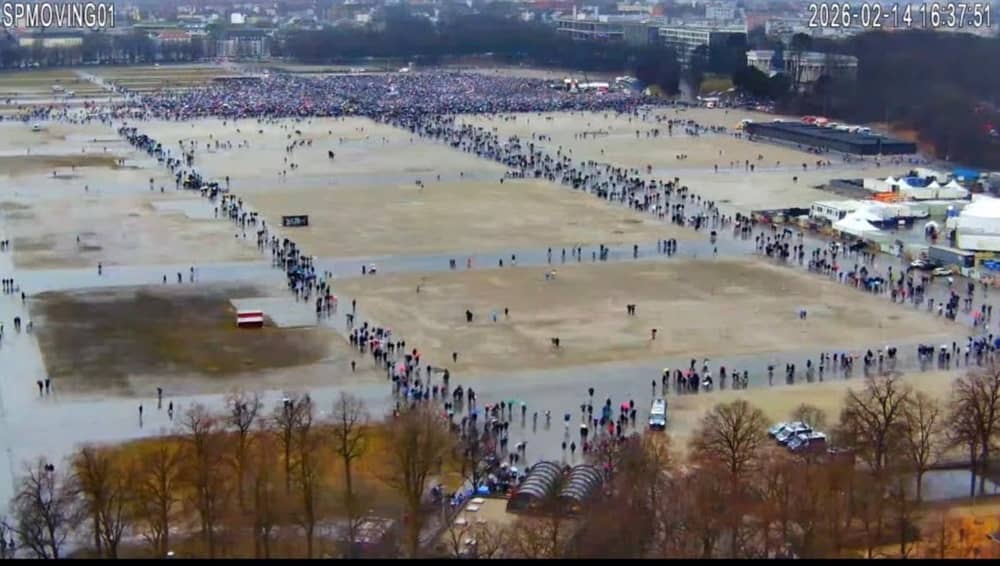
On February 14, 2026, as officials convened for the Munich Security Conference, a separate scene unfolded on Theresienwiese. Reza Pahlavi, the exiled son of Iran’s deposed shah, took the microphone. Chants of “Pahlavi for Iran,” “Javid shah” (“long live the shah”), and “Reza II” rolled across the field. The dominant message was neither the plight of prisoners nor a roll call of the dead from recent crackdowns; it was the elevation of one individual as an inevitable leader, alongside an appeal for foreign—chiefly American—military intervention to topple Tehran quickly.
Some Western media amplified inflated attendance claims that stood in stark contradiction to precedents from previous similar gatherings and to visual comparisons with familiar large-scale events like football stadium attendances or rallies in 2025. Yet the core risk lies not in the disputed scale of the crowd itself. It is the political logic the spectacle normalizes: that mass visibility equates to legitimacy, and that such legitimacy can then be converted into democratic mandate through external intervention or pressure.
The Munich demonstration relied on familiar ingredients: pre-revolutionary symbols, instructed slogans, and digital amplification that turns a rally into a global “trend.” But virality is not consent. Durable legitimacy is institutional, not performative—built through inclusive rules that constrain executive power, protect minorities, and survive succession. A movement that reduces Iran’s future to a single surname invites Iranians to trade one form of unaccountable rule for another.
Ambassador @LBJunior slams Reza Pahlavi and Iranian monarchists for treacherous strategies and their rooting for engagement with the #IRGCterrorists on "The Untold Story" podcast.#FreeIran2024 pic.twitter.com/HOe3ZTaARM
— NCRI-FAC (@iran_policy) June 22, 2024
The Folly of Inviting Foreign Intervention
At the heart of the Munich appeal lay an explicit demand: external intervention to hasten the regime’s fall. Pahlavi warned that further delay would cost lives, urging decisive action—military if necessary—to neutralize repression and enable a rapid handover. This prescription, though presented as humanitarian necessity, defies the hard lessons of recent history.
Over the past two decades, foreign intervention across the region—often sold on promises of rapid democratisation and “civilian protection”—has repeatedly produced the opposite outcome: state collapse, sectarian bloodshed, the rise of extremist groups, and protracted civil conflict. These campaigns have consumed vast resources and taken countless lives, only to end in fragmentation, militia rule, and the return or empowerment of the very forces they claimed to defeat.
Each case reveals the same fatal logic: foreign imposition rarely plants the seeds of stable self-government; it sows resentment, vacuums of power, and cycles of violence. Each produced millions of displaced people and refugees that changed the social and economic world order for good.
#Iran News: State-Run Newspaper Says Reza Pahlavi and Monarchists Have Served Clerical Regimehttps://t.co/iey2VpMKXU
— NCRI-FAC (@iran_policy) April 8, 2025
Pluralism: The Sole Foundation for Enduring Freedom
Iran is not a monolith waiting for a savior. Its nearly ninety million people include Persians, Azeris, Kurds, Baloch, Arabs, Turkmen, and others—communities with distinct languages, histories, and grievances. Any post-theocratic order that treats this diversity as a footnote will invite fragmentation or a renewed tyranny. Enduring freedom requires pluralism: enforceable protections for minorities, secular governance that separates faith from coercive power, and credible power-sharing arrangements so that no group becomes a permanent winner and no minority a permanent hostage.
And this is precisely where the monarchist current—loud, well-resourced, and disproportionately amplified abroad—often fails the democratic test. Instead of widening the circle of opposition, it narrows it: dismissing republicans, secular democrats, non-Persian ethnicities and grassroots organizers as illegitimate or “separatists,” as though Iran’s liberation can be reduced to a single surname. That posture does not prepare a democratic transition; it rehearses the very habit of monopoly that Iranians are trying to escape.
Reports and whispers of intimidation against critics in the diaspora only deepen mistrust and fracture solidarity at the moment it is most needed. Democracy is not merely the removal of clerics; it is the construction of rules and institutions that allow rivals to speak, organize, and compete without fear—so that Iran’s next order is accountable to the whole nation, not captured by a foreign-funded faction abroad.
Munich Press Conference Spotlights #Iran’s 2026 Uprising and the Regime’s Violent Crackdown #No2ShahNo2Mullahs #NCRIAlternative #MSC2026 https://t.co/tJ1w6Y0iJe
— NCRI-FAC (@iran_policy) February 14, 2026
What Iran needs
Iran’s struggle does not begin in exile—and it does not need to be invented for Western consumption. There is already a fighting and battle-tested network inside the country, demonstrating its capabilities during the January 2026 uprising, when insurgent neighborhoods and organized local resistance briefly wrested control of towns and city districts, torched symbols of repression, and crippled parts of the state’s coercive machinery. That reality matters because it punctures the two convenient fictions that still shape foreign commentary: that the regime is “official Iran,” and that Iranians must choose between clerical rule and regime-benign, made-for-TV substitutes.
The minimal moral clarity required is not to “manage” Iran’s future, but to stop laundering the dictatorship as the nation’s legitimate representative, stop amplifying counterfeit alternatives, and recognize a people’s right to resist repression—and to overthrow their oppressors—on their own terms.